
2026 Best Solar Panels For Home Which Type Is Best?

Choosing the 2026 best solar panels for home use is not simply a race for the highest efficiency number. Your roof, climate, electricity rate, shading, and budget can change the answer. A sleek panel may perform poorly beneath morning shadows or on a roof facing the wrong direction. Real homes are less perfect than product brochures suggest.

Abigail Ross Hopper, president and CEO of the Solar Energy Industries Association, has said, “Solar energy is the fastest-growing source of energy in the United States.” Her industry perspective highlights solar power’s growing importance, but popularity should not replace careful comparison. Homeowners still need reliable warranties, verified degradation rates, installer experience, and clear pricing. A panel producing 22% efficiency may look impressive, yet a slightly less efficient model could offer better value over twenty-five years.

This guide examines monocrystalline, thin-film, and emerging solar technologies for residential use. It considers performance in heat, low-light conditions, limited roof space, and changing household energy needs. It also explores battery compatibility and long-term maintenance. Details matter.

There is no universal winner. That is the uncomfortable part. Manufacturer claims can sound precise, while real-world output varies with dust, temperature, wiring, and installation quality. Even expert recommendations deserve a second look. The best Solar Panels For Home should match your property, consumption pattern, and financial expectations—not merely the newest specification sheet.
2026 Best Solar Panels For Home Which Type Is Best?

How Home Solar Panels Work: PV Cells, Inverters, and 20–25% Efficiency

Home solar panels work through a chain of simple but precise steps. Photovoltaic, or PV, cells absorb sunlight and release electrical charges. These charges create direct current electricity inside the panel. An inverter then changes direct current into alternating current for household appliances.

Most modern home panels reach about 20–25% efficiency under laboratory conditions. That figure describes sunlight converted into usable electricity, not your total daily output. Heat, shade, dust, roof direction, and wiring losses reduce performance. Clouds soften output. A clean panel may still produce less power during a hot afternoon.

A proper assessment measures roof angle, local sunlight, and yearly electricity use. I would also check nearby trees at different times of day. Small shadows can affect several connected cells. Panel selection should consider durability, available roof space, and inverter compatibility, not efficiency alone. Battery storage can shift surplus daytime power into evening use, but it adds cost and maintenance. The neat percentage can mislead. Real homes are messier than test conditions. Even careful estimates need review after installation, especially when seasonal demand changes.

Monocrystalline, Polycrystalline, and Thin-Film Panels: Efficiency and Cost

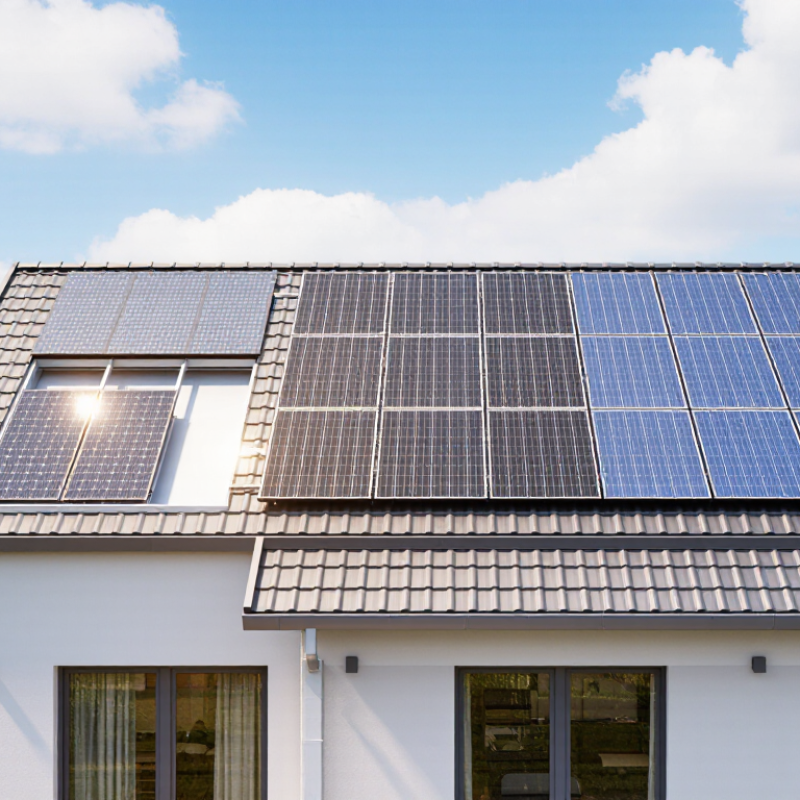
For most homes in 2026, monocrystalline panels offer the strongest balance of efficiency, space, and long-term value. Fraunhofer ISE’s Photovoltaics Report places commercial monocrystalline module efficiency roughly between 20% and 23%. On a small roof, that difference matters. More power fits above a dormer, chimney, or shaded vent. However, higher efficiency usually brings a higher purchase price.

Polycrystalline panels generally cost less, but their efficiency is commonly lower, often around 17% to 20% in recent market data. The savings can be useful on a large, unshaded roof. Yet installation labor, wiring, permits, and inverter costs may remain similar. The cheaper panel does not always create the cheaper system. IEA PVPS reported that crystalline-silicon technology represented more than 95% of global photovoltaic production, showing its mature supply chain and broad technical acceptance.

Thin-film panels deserve a closer look. They can perform steadily in hot conditions and diffuse light, while some designs weigh less than glass-heavy modules. Their efficiency is often lower, approximately 10% to 19%, depending on the technology and product class, according to Fraunhofer ISE. That means a larger roof area may be necessary. I would not choose thin-film automatically for a typical townhouse. On a weak roof or a broad commercial-style roof, its lower weight could change the calculation. Real shade patterns, roof structure, local labor, and electricity prices should decide the final choice. Reports provide useful ranges, not promises for every home.

2026 Best Solar Panels for Home: Which Type Is Best? — Monocrystalline, Polycrystalline, and Thin-Film Panels: Efficiency and Cost

Comparison Factor Monocrystalline Polycrystalline Thin-Film
Typical module efficiency 19%–23% 15%–18% 10%–13%
Indicative module-only cost in 2026 (USD per watt) $0.20–$0.35/W $0.18–$0.30/W $0.20–$0.40/W
Space required for the same system size Lowest; suitable for smaller roofs Moderate to high Highest; requires more roof or ground area
Typical temperature coefficient Approximately −0.35% to −0.40% per °C Approximately −0.37% to −0.40% per °C Approximately −0.20% to −0.30% per °C
Performance in hot conditions Good, but output declines as temperature rises Good, with a similar heat-related output reduction Generally very good because of the lower temperature coefficient
Low-light and diffuse-light performance Good Good Often good, particularly in some overcast conditions
Typical first-year degradation Approximately 1%–2% Approximately 1%–2% Approximately 1%–3%, depending on the technology
Typical annual degradation after the first year Approximately 0.3%–0.5% per year Approximately 0.4%–0.6% per year Approximately 0.3%–0.5% per year for many modern products
Expected service life 25–30+ years with gradual output reduction 25–30 years with gradual output reduction 20–30 years, depending on the film technology and installation
Appearance Usually uniform black or dark appearance Usually blue, with a more visibly textured surface Uniform dark surface; some products are flexible or lightweight
Weight and installation considerations Standard framed installation; moderate weight Standard framed installation; moderate weight Some options are lightweight, but mounting requirements vary widely
Main advantages Highest efficiency, strong space utilization, mature residential option Lower upfront module cost and established manufacturing process Good heat performance, low weight for some designs, and flexible installation possibilities
Main disadvantages Usually costs more than polycrystalline modules Lower efficiency requires more roof area Lower efficiency, greater area requirements, and less uniform product availability
Best fit for homeowners Homes with limited roof space or a preference for maximum long-term energy production Large roofs where reducing module cost is more important than maximizing efficiency Lightweight structures, hot climates, selected low-load roofs, and specialty installations
Note: Cost figures are indicative module-only ranges in U.S. dollars per watt for 2026. They exclude labor, mounting hardware, wiring, inverter equipment, permits, storage, taxes, and local incentives. Actual performance and pricing vary with design, climate, roof orientation, shading, and installation quality.

TOPCon, HJT, and IBC Panels in 2026: Comparing 22–24%+ Efficiency

2026 Best Solar Panels For Home: Which Type Is Best?

TOPCon, HJT, and IBC modules now compete in the 22–24%+ efficiency range. The Fraunhofer ISE Photovoltaics Report 2024 places leading crystalline-silicon modules above 23% efficiency. Its data also shows how quickly advanced cell designs are narrowing the gap with laboratory results. ITRPV’s 2024 roadmap identifies TOPCon as a major mainstream technology, supported by strong manufacturing scale and improving energy yield.

TOPCon usually offers the most balanced choice for residential roofs. It combines high efficiency with established production methods and competitive pricing. HJT can perform strongly in hot conditions because its temperature coefficient is generally favorable. That matters on dark roofs during July afternoons. IBC places electrical contacts on the rear, creating a clean front surface and excellent efficiency potential. However, higher purchase costs may reduce its practical payback.

Real rooftop selection needs more than a percentage. Shade, roof direction, inverter limits, snow, and installer quality can change annual output. The U.S. Department of Energy reports that shading and system losses can materially reduce expected generation, even with premium modules. A 24% panel is not automatically better on a shaded east-facing roof.

My assessment is less tidy. TOPCon often wins the value argument, while HJT suits hot or space-limited roofs. IBC may reward homeowners with expensive, constrained roof areas. Efficiency claims also deserve caution. Manufacturers sometimes emphasize cell efficiency instead of complete-module performance. Check the datasheet, warranty terms, degradation rate, and independent testing before deciding.

2026 Best Solar Panels for Home: Which Type Is Best?

Representative module-efficiency comparison of TOPCon, HJT, and IBC solar panels available for residential applications in 2026.

IBC panels typically achieve the highest module efficiency because their rear-contact design reduces front-side shading. HJT panels generally combine high efficiency with a strong temperature coefficient, while TOPCon panels offer a balanced combination of efficiency, performance, and broad residential availability. Actual results vary by module design, installation conditions, temperature, shading, and system configuration.

Panel Performance Metrics: 0.3–0.5% Annual Degradation and 25–30-Year Warranties

Choosing the best solar panel for a home requires more than comparing wattage. Long-term performance matters.

I compare rated output, temperature behavior, shading tolerance, and documented degradation rates. A panel producing 400 watts in a laboratory may perform differently on a hot, dusty roof. Roof direction, ventilation, and installation quality also affect daily energy production. Numbers need context.

Annual degradation usually ranges from 0.3% to 0.5%. At 0.3%, a panel may retain about 91% of its original output after 30 years. At 0.5%, retention may fall closer to 86%. That difference can influence lifetime savings, especially for homes with limited roof space. It is not dramatic in the first few years. It becomes noticeable later.

Warranty language deserves careful attention. A 25–30-year performance warranty should state the minimum power retained at specific milestones. A product warranty covers physical defects, but coverage terms and claim procedures vary. Read the exclusions. I would also check whether labor, removal, and replacement shipping are included. Some energy estimates assume perfect sunlight and ignore seasonal dirt or partial shading. That weakens their reliability. A slightly lower-rated panel with stronger documented retention may outperform a higher-rated option in real conditions. Perfect assumptions rarely survive on an actual roof.

Choosing the Best Solar Panel by Roof, Climate, Budget, and Energy Use

2026 Best Solar Panels for Home: Which Type Is Best?

Choosing the best solar panel starts with your roof, not a product brochure. A south-facing roof with limited shade can favor high-efficiency crystalline-silicon panels. They use less roof space. Fraunhofer ISE’s 2024 Photovoltaics Report shows commercial crystalline-silicon modules commonly exceed 20% efficiency. However, efficiency alone does not guarantee better savings. A shaded roof may produce less energy than a larger, lower-cost system in open sunlight.

Climate changes the decision. In hot regions, compare temperature coefficients because panel output falls as cell temperature rises. In snowy or storm-prone areas, check tested mechanical-load ratings and local installation requirements. The IEA PVPS Trends 2024 report recorded about 456 gigawatts of new solar capacity worldwide in 2023. That scale supports solar’s maturity, but home results remain highly site-specific. Use local weather data and shade measurements, not national averages.

Budget and energy use must match. Review twelve months of electricity bills, then model seasonal demand with NREL’s PVWatts tool. Oversizing may waste money when export payments are limited. My own early sizing mistake was ignoring evening consumption; the roof produced plenty at noon, but the home still bought power after sunset. NREL research commonly uses about 0.5% annual module degradation, yet real maintenance, dirt, and shading can differ. Leave room for uncertainty. A cheaper system with easy roof access may outperform a premium system that requires costly structural work.