
How to Choose a Forklift Battery in 2026?
Choosing a Forklift Battery in 2026 is not simply a lithium-versus-lead decision. It is a shift-by-shift calculation involving truck compatibility, operating hours, charging access, temperature, maintenance capacity, and lifetime cost. A battery may fit the compartment yet fail operationally if charging windows are too short or a spare is unavailable. Small details matter. Measure the battery tray, confirm voltage and connector specifications, and check the truck manufacturer’s limits before comparing quotes.
Industry benchmarks help, but they need careful reading. BloombergNEF reported that average lithium-ion battery-pack prices fell 20% in 2024, reaching $115 per kilowatt-hour. This broad market figure is not a forklift-pack quote; it excludes factors such as installation, chargers, and downtime. The Battery Council International’s U.S. National Recycling Rate Study reports that about 99% of lead batteries are recycled in the United States. That highlights the value of a clear end-of-life plan, though recycling rates alone do not determine the best battery for a particular fleet. Be cautious.
This guide compares battery types through practical measures: energy use per shift, charging infrastructure, maintenance needs, expected service life, and total ownership cost. It also covers site conditions and supplier questions that can reveal hidden expenses. No spreadsheet captures every awkward shift change. Real operating data still matters, and estimates should be checked against your own fleet. The aim is a better-informed choice, not a one-size-fits-all answer.
Identify the Main Forklift Battery Types Available in 2026
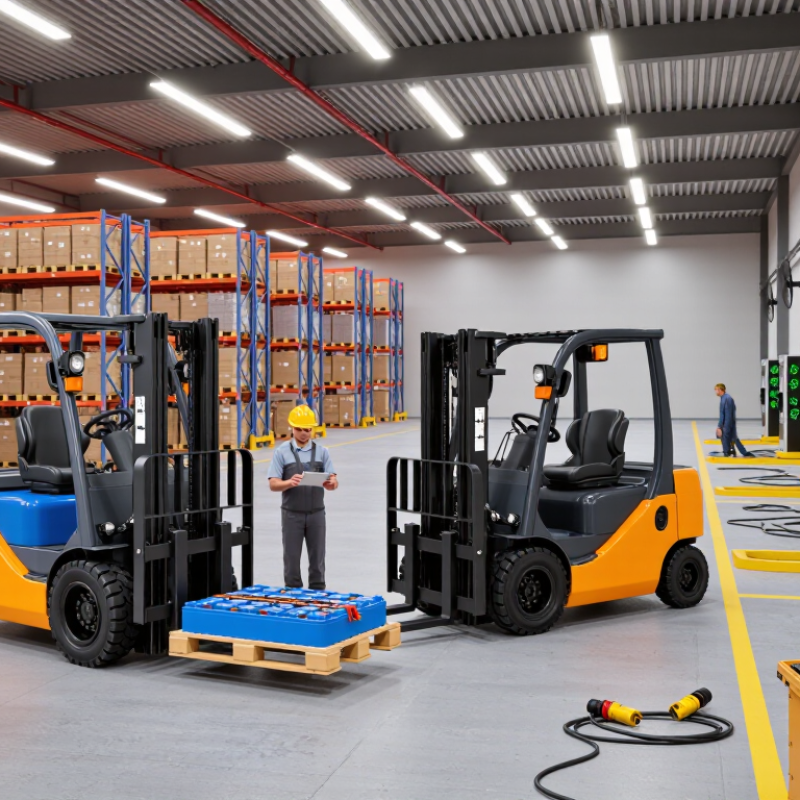
In 2026, forklift power systems mainly use flooded lead-acid batteries, sealed lead-acid batteries, lithium-ion batteries, or hydrogen fuel cells. The right category depends on shift length, charging access, and the truck’s specifications. The labels are useful, but actual operating costs do not always fit neatly into them.
Flooded lead-acid batteries are familiar and often suit predictable shifts. They need regular watering, ventilation during charging, and a designated charging area. That detail matters. Sealed lead-acid versions, including AGM and gel types, reduce watering tasks, but still require suitable charging and routine inspection. They are not automatically maintenance-free.
Lithium-ion batteries can accept opportunity charging during breaks, which may help operations running multiple shifts. Check charger compatibility, battery management requirements, and whether the truck supports the selected battery. Hydrogen fuel cells can be refueled quickly, but need fuel supply and dedicated site equipment. They may fit high-use fleets better than occasional-use trucks. Still, a fast refuel does not make the full system simple or inexpensive. Compare the real duty cycle, downtime, and facility needs before deciding.
Assess Your Forklift’s Specifications and Daily Workload
Before comparing forklift batteries, record the truck’s rated voltage, required capacity, battery-compartment dimensions, connector type, and permitted battery weight. Check the manufacturer’s data plate and operating manual; a battery that fits physically may still be unsuitable electrically or structurally. Measure the compartment, too. Old measurements can be wrong.
Then map a typical workday. Note operating hours, load weights, travel distances, lift heights, and time spent waiting or idling. A truck moving heavy pallets up ramps for two shifts has different energy demands from one handling light cartons indoors. Include attachments and seasonal conditions, since both can change runtime. Ask operators when power drops, not just when charging begins.
Use several days of shift records rather than relying on a single busy day. Compare the estimated energy demand with the battery’s usable capacity and the site’s actual charging windows. A short lunch break may not be enough for a meaningful recharge, while frequent partial charging may not suit every battery type. That assumption needs checking. If one truck works irregular hours, talk with a qualified battery or equipment technician before choosing a capacity. A neat spreadsheet helps, but it cannot capture every rough floor, cold morning, or last-minute extra load.
How to Choose a Forklift Battery in 2026: Match Capacity to Daily Workload
This illustrative example assumes a 48 V, 600 Ah battery (28.8 kWh nominal, about 23 kWh usable at an 80% depth of discharge) and an average forklift draw of 4 kW while operating. Estimate your actual energy use from the forklift specifications and measured workload; longer or more demanding shifts may require a larger battery, opportunity charging, or a battery change.
Compare Battery Chemistry, Capacity, and Performance
How to Choose a Forklift Battery in 2026?
Compare battery chemistry, capacity, and performance against the work your forklift actually does. Lead-acid batteries often suit predictable shifts with time for full charging and regular maintenance. Lithium-ion batteries can support opportunity charging during breaks, but require compatible equipment and careful cost comparison. Neither chemistry is automatically better. Heat matters. A cool warehouse and a hot loading dock can produce different results, so check the battery’s operating range and your site conditions.
Capacity is measured in amp-hours, but a larger number alone does not guarantee a better fit. Match voltage to the forklift’s specification, then estimate energy use across a typical shift. Note loads, travel distance, lift height, and idle time. If the truck repeatedly slows near shift end, the battery may be undersized—or the duty estimate may be wrong. Check charging time, charger compatibility, expected cycle life, and battery weight before deciding.
Tips: Keep a week-long log of shift length, charging breaks, and low-charge alerts. Compare real use with the battery’s rated capacity. Measure twice. A small mismatch in voltage, dimensions, or connector fit can create avoidable downtime. Check these details with the forklift manual or a qualified service technician.
Evaluate Charging Needs, Safety, and Total Cost of Ownership
How to Choose a Forklift Battery in 2026?
Start with the work pattern, not the battery chemistry. Record shift length, loaded travel time, breaks, and overnight charging hours. A truck that runs two shifts may need opportunity charging, a spare battery, or a carefully planned charging window. Check that the charger matches the battery’s chemistry and voltage. Space matters, too. A charger beside a busy aisle can create traffic and heat problems. For lead-acid batteries, plan for designated charging areas, ventilation, and safe handling equipment. Train operators on the exact charging and inspection steps. Small oversights add up.
Safety and energy costs deserve equal attention. NREL’s 2024 Annual Technology Baseline uses about 85% round-trip efficiency for utility-scale lithium-ion storage; this is a useful reference, not a forklift performance guarantee. Actual results depend on the battery, charger, and duty cycle. BloombergNEF reported an average lithium-ion pack price of $115 per kilowatt-hour in 2024, down 20% from 2023. That market figure is not a forklift battery quote. Still, it shows why replacement timing and future prices can complicate forecasts.
Compare total ownership costs across the expected service life: purchase, electricity, chargers, maintenance, replacement, and downtime. Ask suppliers for duty-cycle data and warranty terms, then test estimates against your own shifts. I would challenge any calculation that assumes every truck returns to charge on schedule. Real operations rarely behave so neatly. A short site trial can expose missed charging windows, inconvenient battery changes, or charging bottlenecks before they become expensive habits.
How to Choose a Forklift Battery in 2026? - Evaluate Charging Needs, Safety, and Total Cost of Ownership
| Evaluation factor | Flooded lead-acid | Lithium-ion (typically LFP) | What to check before choosing |
|---|---|---|---|
| Best-fit operating pattern | Often suited to predictable, single-shift work with time available for a full recharge and battery cooling period. | Often suited to multi-shift or high-utilization work where short charging breaks can help keep equipment in service. | Record operating hours per shift, shifts per day, peak workload, and planned break times. |
| Typical charging approach | Usually charged in a dedicated charging area. A full charge commonly takes about 8 hours, followed by a cooling period; actual time depends on battery capacity and charger output. | Can generally accept opportunity charging during breaks when the battery and charger are designed for it. Full-charge time varies with capacity, charger power, and battery management limits. | Confirm charger compatibility, available electrical capacity, connector type, charge schedule, and whether opportunity charging is permitted by the battery manufacturer. |
| Energy replenishment and shift planning | Operations may need spare batteries and battery-changing equipment when trucks run continuously across multiple shifts. | May reduce battery changes in suitable applications, but charging access and charger availability still need to match fleet demand. | Calculate the number of trucks charging at the same time and check whether the facility can support their combined electrical load. |
| Routine maintenance | Requires regular electrolyte-level checks and watering with suitable water, plus terminal and battery-condition inspections. Equalization charging may be required according to the manufacturer’s instructions. | Typically requires less routine battery maintenance, but still needs inspections of cables, connectors, enclosure, and battery-management alerts. | Include labor time, training, maintenance supplies, inspection procedures, and service support in the cost comparison. |
| Indicative cycle life | Often around 1,000–1,500 cycles under specified test conditions; actual life depends heavily on depth of discharge, charging, temperature, and maintenance. | Many industrial LFP products are rated for several thousand cycles; the rating depends on cell design, operating limits, and the manufacturer’s test method. | Compare cycle-life ratings only when test conditions, permitted depth of discharge, and end-of-life definition are stated consistently. |
| Usable battery capacity | Repeated deep discharges can shorten service life; system sizing commonly allows a reserve rather than assuming all rated capacity is routinely usable. | Often supports a greater usable share of rated capacity, within the battery’s specified operating limits. | Size from the truck’s measured energy use and required runtime. Confirm rated and usable kilowatt-hours with the supplier. |
| Safety and work area | Charging can produce hydrogen gas, and electrolyte is corrosive. Follow ventilation, ignition-control, personal-protective-equipment, spill-response, and eyewash requirements. | Does not require routine electrolyte watering, but lithium-ion batteries still need suitable charging controls, damage inspection, thermal-event procedures, and emergency planning. | Review applicable fire, electrical, ventilation, and workplace requirements; use the battery and charger documentation to establish site procedures. |
| Space and infrastructure | May require a designated charging and maintenance area, along with room and equipment for safe battery handling where batteries are changed. | May reduce battery-changing and watering needs, but requires compatible chargers, suitable electrical infrastructure, and an approved charging location. | Assess floor space, ventilation, power capacity, charging locations, battery weight, and any required lifting equipment. |
| Performance considerations | Voltage can decline as the battery discharges, which may affect performance depending on the truck and application. | Battery-management controls can maintain a more consistent output within operating limits; performance depends on the battery, truck, and temperature. | Test with the actual truck and workload, especially for ramps, cold areas, heavy loads, and long travel distances. |
| Purchase and replacement cost | Initial purchase cost is often lower, but total cost can include watering labor, charging-area needs, spare batteries, and battery changes. | Initial purchase cost is often higher, while reduced maintenance or battery changes may offset some costs in high-utilization operations. | Request itemized quotations covering the battery, charger, installation, warranty, service, and any required electrical upgrades. |
| Total cost of ownership (TCO) | Compare costs over the same evaluation period: purchase and installation + electricity + maintenance labor and materials + spare batteries or change equipment + downtime + replacement and disposal costs − any applicable residual value. | Use site-specific electricity rates, measured energy use, utilization, labor costs, warranty terms, and realistic replacement timing. Do not compare purchase price alone. | |
| Decision guide | Consider when utilization is moderate, charging downtime is acceptable, and trained staff and a suitable charging area are available. | Consider when utilization is high, charging breaks are available, and the facility can support compatible charging and safety requirements. | Validate battery dimensions, weight, voltage, capacity, connector, and truck approval before ordering. |
Note: Values and operating characteristics are indicative, not guarantees. Battery performance, charge time, cycle life, safety requirements, and TCO vary by product, truck, charger, site conditions, and operating practices. Confirm specifications with the battery and truck manufacturers and applicable local regulations.
Verify Battery Compatibility and Select the Best Option
Before comparing forklift batteries, confirm the truck’s required voltage, battery-tray dimensions, connector type, and minimum battery weight. These details are usually listed in the equipment manual or on the identification plate. Measure the compartment yourself; older trays may be bent or modified. Measure twice. A battery that fits physically may still be unsuitable if its weight affects the truck’s rated capacity or stability.
Check the battery chemistry against the charging equipment. Lead-acid and lithium systems may require different chargers, charging profiles, and ventilation arrangements. Confirm the charger’s output, plug configuration, and site power supply with a qualified service technician. Then compare the duty cycle: operating hours, lift intensity, breaks, and available charging time. Cold storage, long travel routes, and repeated heavy lifts can reduce usable runtime. Small detail, big impact.
Choose an option that meets the truck’s documented limits and your actual shift pattern, not just the lowest purchase price. Compare usable capacity, expected service life, maintenance needs, charging downtime, and warranty terms. Ask suppliers for written compatibility confirmation and an appropriate commissioning check. Paper specifications cannot fully predict a changing workload. Recheck performance after installation, and record charging behavior, temperatures, and shift-end charge levels. One quiet week may not tell the whole story.